
Indoor air quality is becoming an increasingly important part of how homeowners and businesses think about heating, cooling, comfort, and energy efficiency. HVAC air quality sensors are helping make that possible by providing real-time information about conditions inside a building and, when properly integrated, allowing HVAC systems to respond to changing conditions.
Modern indoor air quality sensors can monitor factors such as carbon dioxide (CO₂), particulate matter (PM2.5 and PM10), volatile organic compounds (VOCs), temperature, and humidity. When connected to smart HVAC controls, this information can help improve ventilation, filtration, comfort, and system operation.
So, what are the biggest HVAC air quality sensor trends in 2026, and what can homeowners and businesses expect in the years ahead?
What Are HVAC Air Quality Sensors?
HVAC air quality sensors are devices designed to monitor indoor environmental conditions and provide information that can help HVAC systems and building occupants make better decisions about ventilation and air cleaning.
Depending on the sensor, it may measure:
- CO₂ levels – often used as an indicator of occupancy and ventilation needs
- PM2.5 and PM10 – fine and coarse airborne particles
- VOCs – gases released by cleaning products, furnishings, building materials, and other sources
- Temperature – helps monitor indoor comfort and HVAC performance
- Relative humidity – important for comfort, moisture control, and mold prevention
- Other pollutants – depending on the technology and application
Indoor air can contain pollutant concentrations that are several times higher than outdoor levels, and recommends strategies such as source control, ventilation, filtration, and air cleaning to improve indoor air quality.
This makes air quality monitoring an increasingly useful component of modern HVAC and indoor air quality strategies.
Why Are HVAC Air Quality Sensors Becoming More Important?
Several factors are driving greater interest in indoor air quality monitoring.
1. Greater Awareness of Indoor Air Quality
People spend a significant amount of time indoors, making the quality of indoor air an important part of comfort and building health.
Dust, particles, chemical pollutants, excess humidity, and inadequate ventilation can all affect indoor environmental conditions. Sensors provide data that can help identify changes that may otherwise go unnoticed.
2. Smarter HVAC Systems
Today’s HVAC systems are increasingly connected to smart thermostats, building automation systems, mobile apps, and other controls.
Adding air quality sensors can provide additional information that helps these systems respond to actual indoor conditions instead of relying only on a fixed schedule.
3. Energy Efficiency
Ventilation and HVAC equipment don’t always need to operate at the same level throughout the day.
For example, CO₂ sensing can be used as part of demand-controlled ventilation (DCV), where ventilation is adjusted according to occupancy-related conditions. The U.S. Department of Energy has highlighted CO₂ sensing as a way to support demand-controlled ventilation and reduce unnecessary ventilation energy use.
4. Healthier Building Design
Indoor air quality is becoming a larger consideration in homes, schools, offices, healthcare facilities, and other occupied spaces.
ASHRAE Standard 241-2023, for example, establishes requirements for controlling infectious aerosols and includes considerations for outdoor air systems and air-cleaning technologies.
Market Snapshot: HVAC Air Quality Sensors in 2026
So, just how big is the market for HVAC air quality sensors?
Actually, it’s bigger than you think, and it’s growing fast. In 2024, the global market for these sensors was valued at approximately $2.5 billion. Fast forward to the next decade, and it’s projected to climb to $5.8 billion by 2033, with steady growth year after year. That’s nearly double the size in less than ten years.
Zooming out even further, the broader HVAC air quality monitoring industry—which covers everything from sensors to smart monitoring systems—is also on a sharp upward curve. Analysts expect it to reach about $75 billion by 2035, up from $46 billion in 2025. Clearly, this isn’t a passing trend—it’s a long-term shift.
But what’s fueling this growth? Three big factors stand out:
Health Awareness
People are becoming more aware of how indoor air impacts their health, especially with growing concerns about allergens, pollution, and respiratory problems.
Smart Building Boom
With homes and offices getting “smarter,” integrating air quality sensors into HVAC systems has become almost standard practice.
Regulatory Pressure
Governments and organizations worldwide are tightening indoor air quality standards, pushing businesses and building managers to invest in advanced monitoring solutions.
Top HVAC Air Quality Sensor Trends in 2026
If you think HVAC air quality sensors are just about measuring CO₂ levels, think again. The technology is evolving rapidly, and 2026 is set to bring some exciting changes. New technologies, stricter air quality standards, and the push for smarter, greener buildings are changing how these sensors are designed, installed, and used. Here are the biggest trends shaping the industry right now:
1. Smarter Integration with HVAC Systems
One of the most important trends is the movement from standalone air quality monitors toward integrated HVAC controls.
Instead of simply displaying an air quality reading, a properly configured system can use sensor information to influence ventilation, filtration, or HVAC operation.
For example, if a sensor detects rising CO₂ in a crowded classroom, the HVAC system can automatically boost ventilation to restore fresh air. This type of demand-controlled ventilation (DCV) helps reduce unnecessary energy use while keeping occupants healthier and more comfortable.2. AI and IoT Are Expanding Air Quality Monitoring
The combination of artificial intelligence (AI), Internet of Things (IoT) technology, cloud connectivity, and HVAC controls is creating new possibilities for building management.
Connected sensors can continuously collect environmental information and send it to a central platform. Software can then identify patterns, generate alerts, and help building operators understand changes over time.
Potential applications include:
- Monitoring unusual changes in humidity
- Identifying recurring increases in particulate matter
- Tracking CO₂ trends
- Monitoring filter performance
- Identifying conditions that may warrant further inspection
- Supporting predictive HVAC maintenance
- Providing remote monitoring for building managers
AI should not be viewed as a replacement for professional HVAC diagnostics. Instead, it can help turn large amounts of sensor data into more useful information.
3. Wireless and Retrofit-Friendly Air Quality Sensors
Installing new technology doesn’t always mean replacing an entire HVAC system.
Wireless and battery-powered sensors can make it easier to monitor indoor conditions in existing homes and buildings. This is particularly useful when installing new wiring would be expensive or disruptive.
For older commercial buildings, schools, offices, and homes, retrofit-friendly sensors can provide a way to introduce modern monitoring without completely rebuilding the HVAC infrastructure.
4. Multi-Parameter Air Quality Sensors
Another major trend is the ability to monitor multiple indoor environmental conditions from a single device.
Instead of installing separate devices for every measurement, some modern systems can monitor combinations of:
- CO₂
- PM2.5
- PM10
- VOCs
- Temperature
- Relative humidity
This provides a broader picture of indoor environmental conditions.
However, it’s important to understand that not every sensor measures every pollutant directly or with the same level of accuracy. Sensor selection, calibration, placement, maintenance, and application all matter.
5. Real-Time Monitoring and Alerts
Consumers and building operators increasingly want to know what is happening inside a building right now—not just during an occasional HVAC inspection.
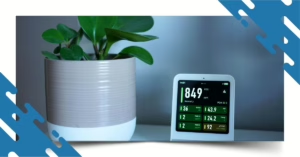
Connected indoor air quality monitors can provide real-time readings through displays, mobile apps, dashboards, or building management systems.
Depending on the system, users may receive alerts when certain conditions exceed a selected threshold.
This can make it easier to identify changing indoor conditions and determine when ventilation, filtration, humidity control, or professional HVAC evaluation may be appropriate.
What Is the Future of HVAC Air Quality Sensors?
The next phase of HVAC air quality technology will likely focus on making sensors more connected, useful, affordable, and easier to integrate.
1. Smaller and More Accessible Sensors
Sensor technology continues to become more compact, allowing monitoring devices to be incorporated into thermostats, HVAC equipment, building controls, and other smart-home products.
As technology becomes more accessible, indoor air quality monitoring may become increasingly common in residential HVAC systems.
2. More Predictive HVAC Management
Future systems will increasingly focus on identifying trends rather than simply reporting current conditions.
For example, a system could identify recurring increases in humidity or particulate levels and alert a homeowner or building manager that further investigation may be appropriate.
This could support a shift from reactive HVAC maintenance to more proactive monitoring.
3. Better Integration With Smart Homes
HVAC air quality sensors are likely to become more closely connected with:
- Smart thermostats
- Home automation systems
- Air purifiers
- Ventilation equipment
- HVAC controls
- Mobile applications
- Building management systems
The goal is a more connected indoor environment where different systems can work together.
4. Greater Focus on Indoor Environmental Quality
The future isn’t just about temperature.
Homeowners and building owners are increasingly considering indoor environmental quality (IEQ), which can include temperature, humidity, ventilation, air quality, acoustics, lighting, and other factors.
HVAC systems will play an important role because heating, cooling, ventilation, filtration, and humidity control directly influence the indoor environment.
5. Sustainability and Efficient Building Operation
As buildings pursue greater energy efficiency, sensor-based HVAC controls can help equipment respond more intelligently to real-world conditions.
The long-term goal is to balance:
Comfort + Indoor Air Quality + Energy Efficiency
Rather than maximizing one at the expense of the others.
The Future of Indoor Air Quality Is Smarter
HVAC air quality sensors are becoming an important part of the transition toward smarter and more responsive HVAC systems.
In 2026 and beyond, expect continued growth in connected sensors, multi-parameter monitoring, smart HVAC controls, AI-assisted analytics, and demand-controlled ventilation.
But technology is only one part of the solution.
Good indoor air quality still depends on the fundamentals: controlling pollution sources, providing appropriate ventilation, maintaining HVAC equipment, and using effective filtration or air-cleaning technologies when appropriate. The EPA continues to identify source control, ventilation, filtration, and air cleaning as key approaches to maintaining good indoor air quality.
The future of HVAC isn’t simply about making buildings smarter. It’s about making them more comfortable, efficient, and responsive to the people inside them.
Frequently Asked Questions About HVAC Air Quality Sensors
Depending on the model, an HVAC air quality sensor may measure CO₂, particulate matter such as PM2.5 and PM10, VOCs, temperature, humidity, and other indoor environmental conditions.
Sensors themselves don’t remove pollutants. They provide information that can help homeowners, building operators, and HVAC systems identify changing conditions and determine whether ventilation, filtration, air cleaning, humidity control, or other solutions may be needed.
Some sensors can communicate with compatible HVAC controls and building automation systems. When properly configured, sensor data may be used to adjust ventilation or other HVAC functions.
Yes. Residential air quality sensors can help homeowners monitor conditions such as CO₂, particulate matter, temperature, and humidity. They can be especially useful when connected to compatible smart-home or HVAC controls.
Most standard indoor air quality sensors do not directly detect mold. Some sensors can monitor humidity and other environmental conditions associated with potential moisture problems, but detecting or identifying mold generally requires a different type of inspection.
Accuracy varies significantly by sensor type, technology, installation, calibration, environmental conditions, and maintenance. A sensor reading should be interpreted within the context of the specific device and application rather than treated as a definitive diagnosis of a building’s air quality.
Placement depends on what is being measured and the purpose of the monitoring system. Sensors should generally be installed where measurements represent the occupied space and away from direct airflow, vents, windows, cooking areas, or other localized sources that could distort readings. Professional installation can help determine appropriate placement.
Potentially. When integrated with compatible HVAC controls, sensor data can help systems respond to actual conditions instead of operating unnecessarily. Energy savings vary by building, equipment, controls, occupancy, and operating conditions.
They are an important part of the trend toward smarter HVAC systems. As connected controls, IoT devices, and data-driven building management continue to develop, sensors can provide the real-time information needed for more responsive HVAC operation.
Take the First Step Toward Cleaner Air
Related Blog Posts
Read more articles and expert advice related to this service.