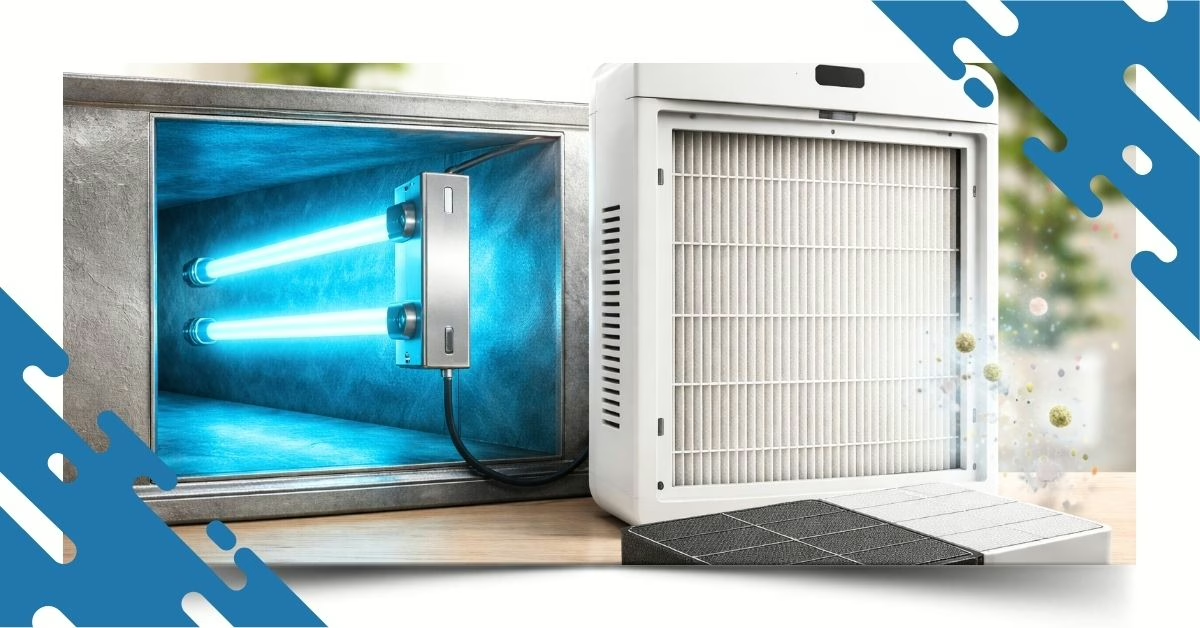
If you’re comparing a UV light vs. HEPA filter for your home, you’re probably looking for a reliable way to improve your indoor air quality. Your HVAC system continuously circulates indoor air, along with particles such as dust, pollen, pet dander, mold spores, and other airborne contaminants.
Both UV-C air purification systems and HEPA air filters can improve indoor air quality, but they work in very different ways.
A HEPA filter physically captures airborne particles, while a UV-C light system uses ultraviolet energy to inactivate microorganisms such as certain bacteria, viruses, and fungi when they receive an adequate UV dose.
So, which is better: UV light or HEPA filtration?
The answer depends on what you’re trying to remove from the air. For many homes, the best approach may be combining effective particle filtration with UV-C technology rather than relying on one technology alone.
In this guide, we’ll explain how UV-C lights and HEPA filters work, compare their benefits and limitations, and help you determine which HVAC air purification solution may be right for your home.
UV Light vs. HEPA Filter: What's the Difference?
The biggest difference between UV lights and HEPA filters is what they do to airborne contaminants.
- HEPA filters capture particles.
- UV-C systems inactivate microorganisms.
Neither technology is designed to do everything. Choosing the right solution starts with understanding what each system is designed to accomplish.
What Is a UV-C Light Air Purification System?
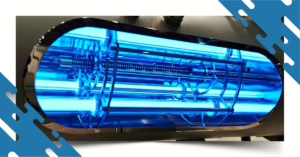
UV lights, especially UV‑C air purification system uses ultraviolet-C energy to inactivate microorganisms when they receive sufficient UV exposure.
UV-C technology can be incorporated into HVAC systems or used in other properly designed air-cleaning applications. In HVAC applications, UV-C lamps may be installed near components such as the evaporator coil or in the air-handling section.
When microorganisms are exposed to an appropriate UV-C dose, the radiation can damage their genetic material and prevent them from reproducing.
UV-C systems may help target:
- Certain bacteria
- Certain viruses
- Fungi and mold-related microorganisms
- Other microorganisms susceptible to UV-C
However, UV-C is not a replacement for filtration.
A UV light does not physically remove dust, pollen, pet hair, or pet dander from the air. Its effectiveness also depends on factors such as UV intensity, exposure time, airflow, lamp condition, system design, and installation.
That means simply installing a UV bulb inside an HVAC system does not guarantee a specific level of microorganism inactivation.
Proper design, installation, maintenance, and safety precautions are important.
What Is a HEPA Filter?
stands for High-Efficiency Particulate Air.
A true HEPA filter is a mechanical air filter designed to capture extremely small airborne particles. According to the U.S. Environmental Protection Agency (EPA), a HEPA filter can theoretically remove at least 99.97% of particles measuring 0.3 microns, which represents a particularly challenging particle size for filtration. Particles larger or smaller than 0.3 microns can also be captured at high efficiency.
HEPA filtration can capture particles such as:
- Dust
- Pollen
- Pet dander
- Mold spores
- Fine particulate matter
- Some airborne bacteria
- Particles that may contain viruses
Unlike UV-C, a HEPA filter captures particles rather than inactivating them.
This makes HEPA filtration particularly useful when your primary concern is airborne particles, allergens, and indoor dust.
However, a true HEPA filter can create significant airflow resistance. It is not automatically appropriate for every existing central HVAC system. Your HVAC equipment and ductwork should be evaluated to determine whether HEPA filtration can be installed without negatively affecting system airflow and performance.
For many central HVAC systems, a properly selected MERV-rated filter may be a more practical option. EPA notes that MERV ratings are used to compare the particle-capturing performance of filters commonly used in heating and cooling systems.
How Do UV Lights and HEPA Filters Compare in Effectiveness?
So, how do UV lights vs HEPA filters actually stack up when it comes to cleaning the air in your home? Understanding their strengths and limitations can help you choose the right solution—or decide if a combination system is best.
To make it easier, let’s look at a side-by-side comparison of key performance factors:
So, how do UV lights vs HEPA filters actually stack up when it comes to cleaning the air in your home? Understanding their strengths and limitations can help you choose the right solution—or decide if a combination system is best.
To make it easier, let’s look at a side-by-side comparison of key performance factors:
Removes dust and pollen | ❌ No | ✅ Yes |
Captures pet dander & allergens | ❌ No | ✅ Yes |
Inactivates bacteria & viruses | ✅ Yes (if exposed long enough) | ❌ Only traps them |
Maintenance required | Moderate (lamp replacement) | Moderate (filter replacement) |
Best use | Germ-heavy spaces, hospitals, HVAC systems | Allergens, everyday indoor air quality |
Works alone effectively | Limited | Yes |
Works best combined with other tech | ✅ Yes | ✅ Yes |
Particle Removal       |■■■■■■■■■■■■■■■■■■ 100% HEPA
Germ Inactivation      |■■■■■■■■■■■■ 70% UV (depends on exposure)
Allergen Capture       |■■■■■■■■■■■■■■■■ 95% HEPAPaste or type your code here…
Note: UV effectiveness varies with airflow, exposure time, and lamp intensity. HEPA effectiveness is consistent when maintained properly.
Both UV lights and HEPA filters have strengths and limitations. UV lights excel at inactivating germs, while HEPA filters are unbeatable at removing dust, allergens, and pet dander. Understanding these differences helps you decide which system—or combination—will give your home the cleanest air possible.
UV-C vs. HEPA: Which Removes More From the Air?
It depends on what you’re trying to remove.
For dust and allergens: HEPA filtration wins
If your main concerns are:
- Dust
- Pollen
- Pet dander
- Fine airborne particles
- Mold spores
then particle filtration is generally the more appropriate technology.
A properly selected HEPA filter can capture at least 99.97% of particles at the 0.3-micron test size under the conditions specified for HEPA filtration.
For microorganisms: UV-C provides a different benefit
If your priority is microbial control, UV-C can provide an additional air-cleaning approach.
UV-C does not remove microorganisms from the air in the same way a filter does. Instead, sufficient UV exposure can inactivate susceptible microorganisms.
Its effectiveness depends on receiving an adequate UV dose. Air moving too quickly through the treatment zone, insufficient UV intensity, poor lamp placement, or dirty lamps can reduce performance.
For comprehensive indoor air quality: consider layered filtration and air cleaning
For many homes, the strongest approach is not necessarily UV light OR a HEPA filter.
Instead, a properly designed indoor air quality strategy may combine:
Particle filtration + UV-C air purification + proper HVAC maintenance + adequate ventilation
Each component addresses different indoor air quality concerns.
UV Lights
Pros
- Inactivates Germs: UV‑C light can effectively neutralize viruses, bacteria, and mold spores when the exposure is sufficient. This makes it ideal for reducing microbial risks in the air.
- Low Ongoing Costs: Unlike filters, there is no continuous material to replace—just periodic lamp maintenance.
- Silent Operation: UV lights do not rely on fans to capture particles, so they operate quietly.
- Good for High-Risk Areas: UV systems are commonly used in healthcare facilities, offices, and spaces where germ control is a priority.
Cons
- Limited Particle Removal: UV lights do not remove dust, pollen, or allergens from the air.
- Effectiveness Depends on Exposure: If airflow moves too quickly past the lamp or the light is poorly positioned, germs may not be fully inactivated.
- Safety Concerns: Direct exposure to UV‑C can be harmful to skin and eyes, so installation must be carefully managed.
- Supplemental Technology: UV lights work best when combined with filtration or other air-cleaning methods.
HEPA Filters
Pros
- Captures Particles: HEPA filters physically trap dust, pollen, mold spores, pet dander, and other airborne particles, making them highly effective for allergy relief.
- Proven Technology: Multiple studies confirm HEPA filters remove 99.97% of particles ≥0.3 microns.
- Safe and Ozone-Free: HEPA filtration does not produce harmful byproducts.
- Versatile Applications: HEPA filters are widely used in home air purifiers, HVAC systems, and medical facilities.
Cons
- Does Not Kill Germs: While HEPA filters trap bacteria and viruses, they do not inactivate them, so trapped microbes can remain on the filter.
- Regular Maintenance Required: Filters must be replaced periodically to maintain effectiveness, which adds ongoing cost.
- Airflow Resistance: High-efficiency filters can reduce airflow in some HVAC systems if not properly sized or installed.
This breakdown makes it clear that neither technology is perfect on its own. For comprehensive air quality, many experts recommend combining HEPA filtration with UV-C systems to remove particles and inactivate microbes simultaneously.
Which Option Is Best for Your Home?
Choosing between UV lights vs HEPA filters ultimately depends on your specific needs and home environment. If allergies, dust, or pet dander are your main concern, a high-quality HEPA filter will provide consistent relief and cleaner air. On the other hand, if you’re worried about germs, bacteria, or mold spores, a UV‑C system can add an extra layer of protection, especially when installed in your HVAC system.
For most households, the most effective approach is a combination of both technologies. A HEPA filter captures airborne particles while a UV light neutralizes microbes, giving you comprehensive protection.
If you’re unsure which option is right for your system, professional guidance makes all the difference. Iron Shield Heating & Air can evaluate your HVAC setup, recommend the right air purification upgrades, and ensure everything is installed safely and correctly.
Contact us today to schedule an indoor air quality assessment and take the first step toward cleaner, healthier air in your home.
Frequently Asked Questions About UV Lights and HEPA Filters
Not necessarily. They perform different functions. HEPA filters are designed to capture airborne particles, while UV-C systems can inactivate susceptible microorganisms when the UV dose is adequate. For comprehensive indoor air quality, a combination of appropriate filtration and UV-C may be beneficial.
Yes. A true HEPA filter can capture mold spores and other airborne particles. However, filtration does not address the underlying source of mold growth. If you have a moisture or mold problem, the source should be identified and corrected.
UV-C can inactivate susceptible microorganisms when they receive an adequate UV dose. However, UV-C should not be considered a complete solution for an established mold problem. Mold growth requires moisture control and appropriate remediation.
No. UV-C lights do not physically remove dust, pollen, or pet dander. Filtration is needed to capture these particles.
No. HEPA filtration captures airborne particles, including particles that may contain microorganisms. It does not use a germicidal process to kill or inactivate them.
It depends on the HVAC system. True HEPA filters can have higher airflow resistance than standard HVAC filters. A professional should determine whether your equipment can accommodate the filter without negatively affecting airflow and system performance.
Replacement intervals vary by manufacturer and equipment. Follow the manufacturer’s maintenance recommendations and have the system inspected periodically to ensure the lamp is operating properly.
Properly installed HVAC UV-C systems are designed to prevent occupants from being directly exposed to UV-C radiation. Because direct UV-C exposure can harm skin and eyes, professional installation and maintenance are important.
Not all UV-C systems produce ozone. Ozone generation depends on the lamp technology and wavelength. If ozone is a concern, ask your HVAC professional or equipment manufacturer whether the specific system is designed to be ozone-free.
For airborne allergens such as dust, pollen, and pet dander, effective particle filtration is generally more directly relevant than UV-C. UV-C may provide an additional microbial-control benefit but does not replace filtration.
Yes. They address different indoor air quality concerns and can be part of a layered air-cleaning strategy when properly designed for the HVAC system.
Related Blog Posts
Read more articles and expert advice related to this service.
One Response
This blog is a great resource for anyone looking to live a more mindful and intentional life Thank you for providing valuable advice and tips